
MILE END KICKS: A LOVE LETTER TO MONTRÉAL
Updated: May 17
Being a 14-year-old Montréal teenager in 2011 at the height of the indie sleaze/hipster era felt magical. American Apparel disco pants, Toms shoes, owl necklaces, Polaroid cameras, and Tumblr dashboards glowing at 2 AM. Millennial optimism was at an all-time high, and Montréal rent was at an all-time low! The city felt like it belonged to artists. I was watching something special unfold in front of my eyes, something electric, something raw, and I wanted in!
WRITTEN BY ROCHELLE ALLEN
I was there, but I wasn’t in it… I was a spectator disguised as a participant. I wore the uniform, studied the references, and reblogged the lifestyle. The freedom, the chaos, the art, I understood it visually before I ever experienced it physically.
Tumblr was my entry point, a digital portal into Brooklyn, Shoreditch, and Mile End. I learned who mattered, what people wore, and how they lived. I was obsessed and immersed in music, fashion, art, and of course, Tumblr. I built an identity through curation before I had the chance to live it. And like so many others, I believed that if I could just get there, to one of those cities, I would finally become who I was meant to be. Montréal was one of those cities, as the birthplace of American Apparel, it solidified that status in history and made our impact on the indie sleaze/hipster scene undeniable.
Known as the cultural capital of Canada, Montréal has long been a magnet for starving artists chasing self-discovery. During this time, we’ve watched pioneers like Grimes, Mac DeMarco, and Arcade Fire turn the Mile End into a global blueprint for "cool” and become some of the pioneers of this emerging sound that you can only find in Montréal and specifically within the Mile End. Mile End was the epicentre of the scene, famously home to artists, musicians, and writers, often associated with the early 2000s indie rock boom. At the premiere of Mile End Kicks, producer Patrick Kiely mentioned his rent back then was only $265. The audience gasped. In 2026, that feels like a fairytale, but in 2011, it was the reality! It was a creative playground that allowed the underground to breathe.
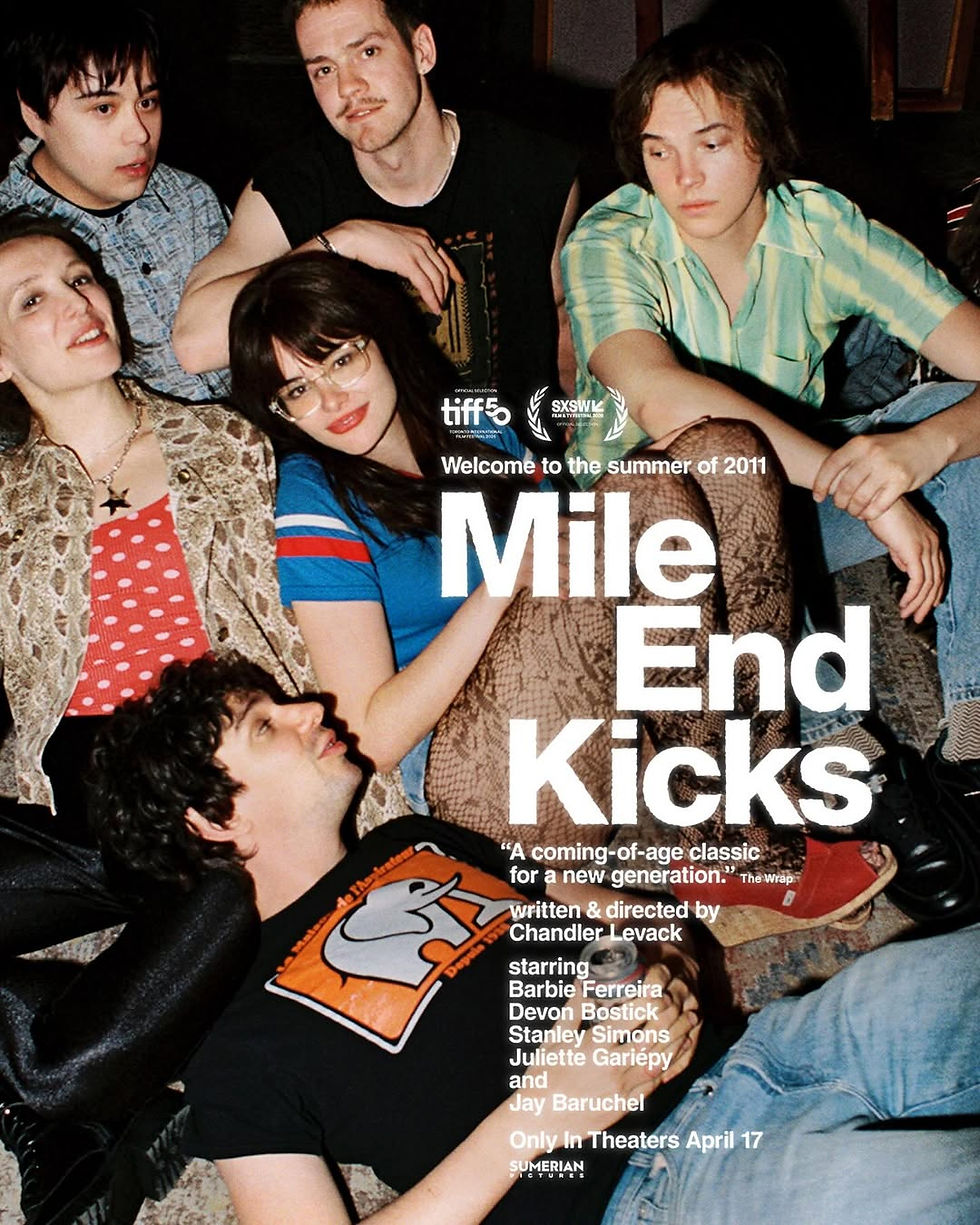
You come here with a dream and survive on cigarettes, St-Viateur bagels, and creative delusion. That mythology is exactly what Mile End Kicks taps into through Grace Pine (Barbie Ferreira), a writer who moves from Toronto to Montréal to work on a book about Jagged Little Pill. Instead, she gets pulled into the orbit of a local indie rock band named Bone Patrol with members Archie (Devon Bostick) and Chevy (Stanley Simons).
Grace doesn’t arrive as an artist. She arrives wanting to become one. That space in between the wanting and the being is where the beautiful chaos lives to create art.
I’ve lived in that space.
At 16, I transferred to an alternative school in Le Plateau/Mile End area, and everything shifted. It felt like stepping into colour after years of black and white. I met people who lived differently, creatively free without apology. I picked up photography and writing again, two things I had always loved but never fully pursued. Then something in me clicked. While watching Mile End Kicks, I recognized an alleyway almost instantly. It transported me back to after-school hangouts with friends, passing around my mom’s Jamaican rum in a silver Urban Outfitters flask, sitting in those perfectly imperfect Montréal back alleys, hidden yet somehow made to be seen.
We all wanted to be seen. Especially me.
By 20, I was chasing proximity, working in fashion retail, attending every concert and music festival I could afford. I interned at New York Fashion Week, snuck into my first show at Spring Studios and somehow ended up front row. In crazy rooms with celebrities, assisting on sets, styling music videos, and doing production and photography at MURAL Festival. From the outside, it looked like I had made it into the world I once watched through a screen. But I was still orbiting, close enough to touch it, but not fully inside.
That’s what Mile End Kicks captures so precisely, the illusion of arrival. The way you can confuse access with belonging. Grace gets pulled in by the band boys, but it’s not just attraction. It’s what they represent. They are the scene. And if she’s close to them, maybe she is too. But what are you willing to lose to be a part of it? Montréal has a way of feeding that delusion, and I lost myself in the pursuit of becoming.
The details in the film are so specific that they feel almost invasive at times. Old iPhone iOS5 interfaces. MacBook photo booth selfies. Pabst Blue Ribbon breath and weed vape rotations at La Fontaine Park, walking to catch the first STM metro in the morning after partying at a DIY loft party all night, rooftop hangs with the mountain glowing in the background. The kind of hyper-local texture that only exists if you’ve lived it.
The audience at the premiere was constantly roaring with laughter, and so was I. And some moments hit too close to home to even register as comedy; it was documentation.
“I don’t have social anxiety. I just, I feel uncomfortable at a party, when I don’t know anyone, and everyone is on cocaine.” - Grace Pine
The film leans into Montréal’s bilingual identity, using Grace’s awkward attempts at French and interactions with her Québécois roommate Madeleine (Juliette Gariépy) and her Québécois boyfriend Hugo (Robert Naylor), who is also in Bone Patrol, as a recurring comedic thread. Director and writer Chandler Levack plays with Québecois stereotypes just enough to make them land without feeling forced. It’s cheeky, self-aware, and grounded in truth. Anyone who’s lived here as an Anglophone has had those exact interactions.
And then there are the local Montréal lore references, the kind you only catch if you’re part of the ecosystem. Concordia dropouts turned artists. Fresh St-Viateur bagels eaten straight out of the bag with a tub of Philadelphia cream cheese. Party scenes that die, the second McGill students show up. I can tell the writers took their time to speak to locals when creating this movie. The details made everything hit even harder!
“This is Mile End, there’s like 75 people.” - Archie
Montréal isn’t a city, it’s a village, and the creative scene is even smaller. That intimacy is part of what makes it so powerful. And so suffocating.
There’s a recurring line in the film: “You can’t be an artist in Toronto.”
It’s exaggerated, but it reflects a real mindset. Toronto is seen as structured, corporate, and financially driven. Montréal, in contrast, prioritizes art over profit, sometimes to a fault. Here, people will take unpaid gigs, stretch themselves thin, and romanticize the struggle in the name of creativity.
But that romanticization comes at a cost.
Grace embodies the darker side of that mythology. She’s broke, behind on rent, stealing her roommate’s food, and spiralling emotionally, all while convincing herself she’s “living the dream”. She abandons opportunities, prioritizes the wrong people, and loses herself in the process.
The relationships in the film are intentionally uncomfortable. The sex is bad. The power dynamics are worse. There’s a scene that made my skin crawl, not because it was shocking, but because it was familiar, that quiet normalization of being treated poorly, of accepting less, of confusing chaos with passion. Montréal will let you get away with that for a while. That’s part of its magic, but also its trap to keep you there. I’ve seen people derail their lives here chasing a version of themselves that doesn’t exist. I’ve done it in smaller ways, choosing distraction over discipline, proximity over purpose.
But what Mile End Kicks does well is break that cycle. Grace eventually snaps. She confronts her boss, demands what she’s owed, and says everything she’s been holding back. It’s messy, overdue, and necessary. That moment felt like a shift, not just for her, but for anyone who’s ever believed that suffering is a requirement for making art.
Because it’s not.
By 25, after years of chasing the high and destroying myself in the process, I had a breakdown. I was in New York, attending fashion school at Parsons School of Design, and the world I had worked so hard to build, my lifelong dreams started crumbling around me, and I couldn’t do anything about it. I got sober, started healing, and my perspective shifted. I stopped orbiting and started building. I moved back to Montréal, and I built BARCODE as a way to document the scene I had spent years trying to access. But it became more than that. It became a platform, a community, an archive of a culture that is constantly evolving and at risk of disappearing under rising costs.
We even shot our first ad campaigns at the same Saint-Henri abandoned silo location featured in the film, where Grace attended her first wine-fuelled public poetry reading. One of those full-circle moments that blurred the line between my reality and the world on screen.
Then there’s the music, the invisible thread holding everything together. Montréal isn’t just seen, it’s heard. Mile End Kicks weaves together indie classics, original Bone Patrol tracks like A/S/L, and contributions from artists like Tops, director Chandler Levack's favourite Montréal indie rock band, and emerging artist Magi Merlin. When Magi Merlin’s voice comes in during the end credits, it doesn’t feel like a soundtrack choice; it feels like a continuation of the story. A week before the premiere, I was at her show, covering it for BARCODE. In the same way, we see Grace covering a show in the intro of the film. Hearing her voice in the film felt like worlds colliding, like the Montréal on screen bleeding into the one I’m living in.
That’s the thing about this city, there’s no separation between the art and the artist, the party and the performance, the film and real life. Music here doesn’t sit in the background. It defines eras. It holds memories in place. I can still trace parts of my life through sound, the tracks that played in dimly lit apartments, the basslines that carried through warehouse walls, the songs that made you feel like you were exactly where you were supposed to be, even if everything else in your life said otherwise. Mile End Kicks understands that by recreating a feeling. And by bringing in artists like Magi Merlin, it quietly bridges the gap between the Montréal of 2011 and the Montréal that exists right now.
The one I’m still living in. The one I’m still documenting.
Now, at 28, I have found my way in, but I see it differently. Being an artist isn’t about proximity. It’s not about who you know, what you wear, or how closely your life mirrors an aesthetic. It’s about choosing yourself over external validation and always staying authentic to your artistic expression, even if others don’t see what you see. I’ve been able to have so many amazing opportunities by doing BARCODE, and I wouldn’t be who I am without my city!
My city, where we would gather together to celebrate life for Tam-Tams every Sunday at the Sir George-Étienne Cartier Monument on Mount Royal. My city, where we would take the shortcuts by the train tracks to get to illegal parties that would get shut down by police, at Van Horne skatepark. My city, where my Doc Martens would dance on the sticky Bar Le Ritz PDB floors. Mile End Kicks captures a version of Montréal that feels both specific to 2011 and timeless in its essence. Just a little charm to lure you in, a sprinkle of chaotic cringe that you can’t look away and just enough awkward funniness to make you stay. And somehow, it made me fall in love with my city again.

Photography by: Joe Fuda
As a local born and raised in Montréal, I’ve always had a love-hate relationship with my city. To finally have a coming-of-age movie highlighting the city’s creative scene, especially during such a special time in music history, feels significant and nostalgic. This movie allowed me to romanticize my city, seeing it through Grace’s eyes, through an outsider trying to make sense of it all, reminded me just how special it truly is. Writing this, I realized something I hadn’t fully articulated before. BARCODE has always been my love letter to Montréal. Not just documenting the underground, but preserving it. Building something that allows artists to do more than survive, but to actually thrive.
The scene that raised me is the heart of this city, but it’s changing. And if we don’t capture it, support it, and evolve with it, we risk losing it. Montréal made me the artist I am today, and no matter where I go, the city's artistic energy, chaos, and freedom will always live in my bones.
xoxo
Rochelle
Mile End Kicks - Only In Theatres April 17th, 2026! Get your tickets here: https://tickets.mileendkicksmovie.com


Comments